
Naturally, an artisan, hard at work, will position their body in ways that reduce fatigue, without compromising power and control. This concept can be explained, mathematically, as a geometry equation, where the results are shown, tangibly, as residual markings on two separate stones: a carving and a tool.
IndianRock.art solstice site – carved stone with matching stone tool
The truth is comprised of the evidence. It is what led us here. The redundancy cannot be overstated or overlooked.
The Garden Site includes discoveries made from the Solstice Site, which I unearthed alongside the Garden Site. Look for the next few posts to focus on this site, because it dives deeper into the various stone tools that make up the Garden Site and IndianRock.art, generally speaking.
I am a finish carpenter of many years, but I also wrench on cars. Tools have always been in my hands, ever since swapping parts on my Tonka trucks. Here at IndianRock.art, I can easily imagine people from long ago requiring tools, at a time when all there was, were stones. In this world, the mind of an architect, engineer, or artisan would get pretty darn creative, when carving out tools from stone. …in my opinion.
IndianRock.art Garden/Solstice site – 3digit shaping tool resembling the front half of a turtle
Power, control, and ergonomics: that’s the name of the game, when it comes to using hand tools. When it doesn’t feel like work: It isn’t. But, when it does feel like work, it’s because of a faulty tool or improper design.
IndianRock.art – example of a detail carving technique represented here, with stones from the Solstice Site.
When I’m playing carpenter and looking to route an edge, I open my box of bits then compare the various cutter shapes.
IndianRock.art – selection of finger tools denoting a common edge of 3/4″ long with an eased corner on one side and a sharp corner on the other
IndianRock.art – stone unearthed at the (Solstice)Garden Site – Shown here to focus attention on a 3/4″ relief that has, potentially, been etched into the stone’s face
Pinched between the thumb and finger, a 2digit stone tool is used on a smaller scale, creating finer and more distinct details.
Here’s an example of a 2digit tool with, what appears to be, a bear cub and human profile carved into it.
IndianRock.art – finger tool with a bear cub and human face profile carved into its surface
Again, I have to repeat: The Lord guides my hands. I find the stones, and they find their place. It all comes so naturally.
The final product: undeniably, a hummingbird in flight
Shaping is done by applying friction onto a given surface, by way of grinding, scraping, sanding, and polishing. During this process, not only is the carved stone being worked: the tools, themselves, will be ground down and will begin to share the same shape with the stone being worked on. In other words, the tool becomes a negative image of the carved area: a square peg in a square hole.
After aligning the edges and angles of the stones to a specific worked surface, one can reverse engineer the process that led to the tools’ final shapes. This includes being able to place the stones in the order in which they were used.
IndianRock.art – garden site inside corner tool cache
The series of images shown below are examples of left-handed tools and the area where they were used. As a note: I’m holding them with my right hand in order to get a clear shot of the worked area.
IndianRock.art Garden Site – view of east facing basestone, shown here for the purpose of highlighting the large indentation that’s ground into the face of the stone.
Look at the image and imagine someone is facing east(left), straddled across the second stone, leaning forward, and with the right hand, is gripping the tip of the first stone. Now imagine, with a stone in the left hand, this individual is creating the large indentation that is clearly visible in the image.
There are the 2digit stone tools, very finite, where the artisan pinches a pebble between the thumb and finger. Then, there are 3digit tools, as mentioned in an earlier post. After finger-held tools, palm tools are next in line.
As the name suggests, the palm tool is held within the grasp of the entire hand. Amongst the many benefits of this positioning, the biggest is that the artisan is utilizing the power and control generated by the muscles and bone structure throughout the arm and shoulder.
IndianRock.art – example of palm-held stone tool
In the mind of a carpenter
If a carpenter is standing still, while swinging a hammer, the distance and angle to the nail determines the dynamic geometry that exists between the body and the subject matter.
Additionally, at the point before collapsing this geometric structure, the carpenter will either compromise the effectiveness of the swing, or the carpenter will change positioning, in order to regain balance: dynamic triangulation.
Dynamic triangulation becomes fluid, as the artisan moves from one position to another. This is the dance of geometry. This critical knowledge exists, hidden behind the physical world. It, along with the geometry of the hand, determines the very shape of these stones: poetry in motion, solidified in stone.
IndianRock.art – examples of small palm-held stone tools
The righteous implication that will forever alter the way of forensic archaeology, prehistoric United States of America, and the original people of this land.
IndianRock.art – Garden site discovery of two stone chisels and one stone hammer presumably left by a working stone carver
I couldn’t believe what I was looking at! Could it be? Were these stones not just tossed into a hole and buried? Was I standing where someone else stood, back in ancient times? More than that though, is this a worksite, where the stone carver set these tools down exactly as I unearthed them?
Let the evidence lead the way, because math and science do not lie. IndianRock.art: taking amateur archaeology to the next level
This standing cairn stone, pictured below, was the first large stone recovered from the Garden Site. It has four sides, representing the cardinal directions: north, east, south, and west. It rests atop the boulder below it, with a marker to help position the stone correctly.
Open eye east face
Closed eye west face
Sun beat south face
Wind blown north face
Interestingly, this standing stone can be laid horizontally spanning across the two larger base-stones, forming a triangular opening between the three stones. This opening faces directly towards the winter solstice midday sun, suggesting that there might be additional stones just north of the site, where the sun might shine onto.
As a child growing up, I would watch ‘National Geographic’ specials on TV. The knowledge gained from those shows came into play, as soon as I noticed the repeating geometric patterns in the stones.
IndianRock.art – stones separated and cataloged
Shortly after noticing these repeating patterns, I referred to my memories of watching archaeologists uncover artifacts on the early NG documentaries. First off, I knew that I needed to log everything that pertained to my growing hypothesis: someone, at some point in time, quarried stones for carving and then buried them, including their stone tools. Additionally, the stones were placed intentionally, in conjunction with the patterns of the sun and moon, as their illumination played upon the surrounding landscape.
So then, I graphed the area, both horizontally and vertically: with each separate area having its own designation, represented by numbers and letters. Then, I systemically unearthed the site, sifting the contents through a 1/8″ screen.
I arrived in Missouri, a man without faith and only to meditate. Little did I know, my life was about to change in ways that I still find difficult to comprehend.
IndianRock.art – Garden Site
For the first couple of years, I just observed the natural flow of nature and its cyclical ties with the sun, moon, and stars.
Hello. Before phase2 of the Garden Site dig begins, I would like to review phase1, which was a preliminary unearthing to determine what it was that I was encountering, while digging in my Missouri garden. This review will consist of a series of posts, containing info on the dig process, discoveries made, and an in-depth preliminary conclusion. Phase2 is scheduled to begin early summer 2026.
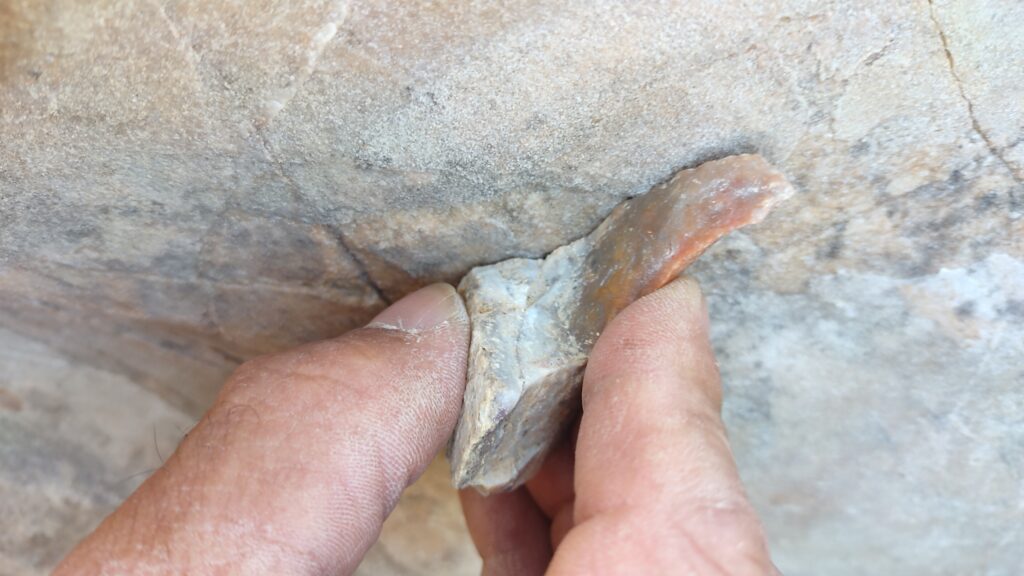
IndianRock.art – example of rock-art forensic archaeology
(Disclosure- I am a seasoned finish carpenter, by trade; and so, I will be leaning on my understanding of finished surfaces, hand tools, and the relationship between the two, in terms of anatomic geometry, range-of-motion, and triangulation- as it plays upon a worked surface: Rock-art forensic archaeology.)